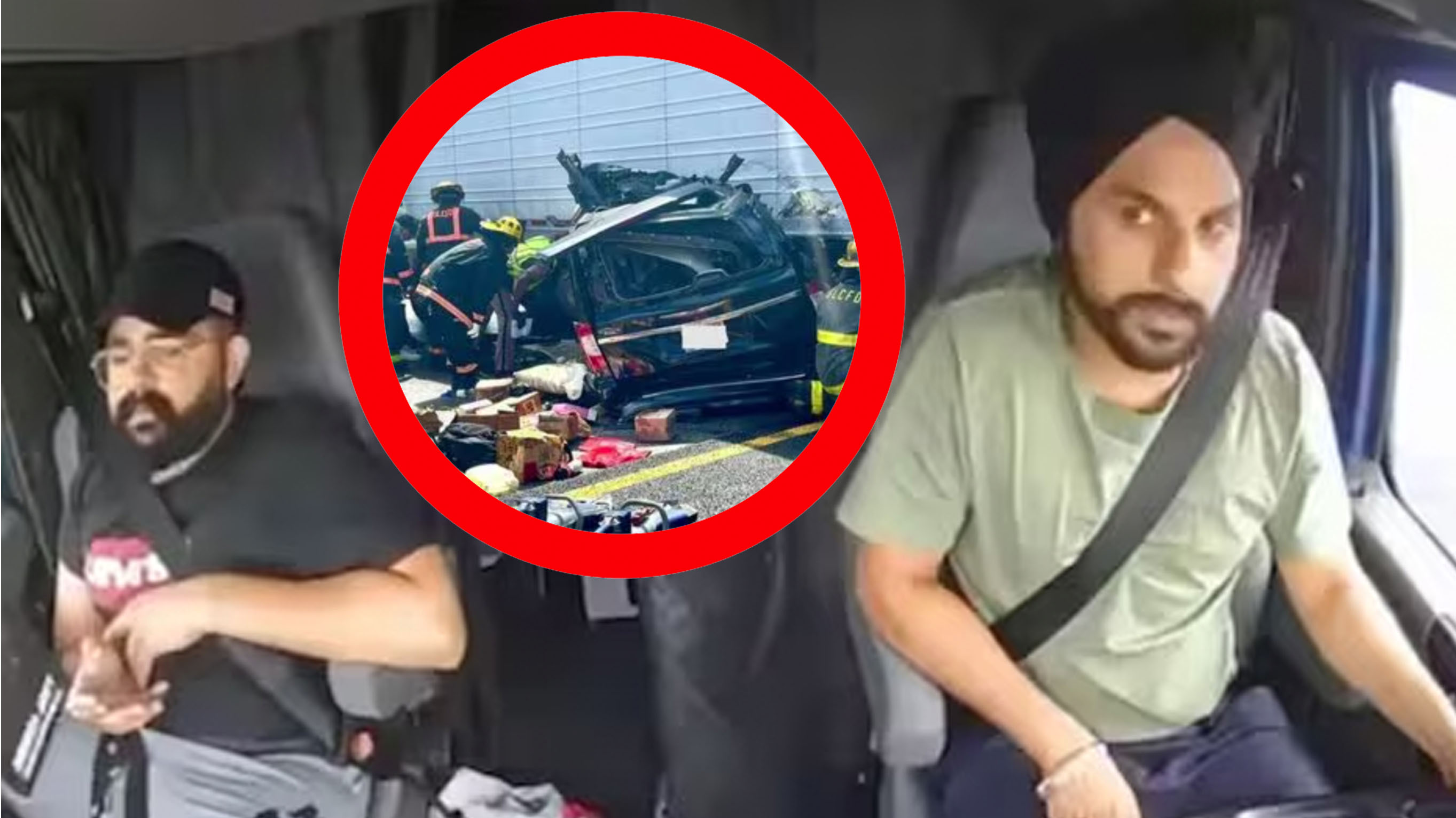
The “Indian Truck Driver Harjinder Singh Florida Accident” refers to a tragic and highly publicized event in mid-August 2025 that swiftly sparked widespread online backlash, intense discourse, and a proliferation of memes. The incident involved an Indian semi-truck driver, Harjinder Singh, who executed an illegal U-turn on the Florida Turnpike in St. Lucie County. This dangerous maneuver resulted in a passenger vehicle colliding directly with the truck’s trailer, leading to the immediate deaths of all three adults inside the minivan.
The severity of the accident was significantly amplified by the viral dissemination of an in-cabin dashcam video. This video, captured from within Singh’s truck, graphically showed the moments leading up to the illegal U-turn, including Singh and a passenger in the cabin just before the impact. The raw and shocking footage rapidly circulated across major social media platforms, including Twitter (rebranded as X) and Reddit, triggering an explosion of criticism aimed at Singh’s reckless driving and the broader circumstances surrounding the collision.
The controversy intensified with subsequent reports identifying Harjinder Singh as a 28-year-old Indian national who had reportedly entered the United States illegally in 2018 through the U.S.-Mexico border. Further reports indicated that he had obtained his Commercial Driver’s License (CDL) in California. This combination of his Indian nationality and undocumented immigration status drastically shifted the online narrative. Initial condemnation of dangerous driving quickly escalated into broader anti-immigration and anti-Indian sentiments. These sentiments found widespread expression through a barrage of memes and online discussions specifically targeting “Indian truck drivers,” generalizing the incident to an entire demographic.
Local Florida news outlet CBS12 reported on August 16th, 2025, that the fatal accident had occurred on August 12th. Following the devastating crash, Singh, accompanied by a 25-year-old passenger named Harneet Singh (who was uninjured), traveled to California. There, Harjinder Singh was detained by authorities and subsequently charged with three counts of vehicular homicide. In a parallel legal development, Immigration and Customs Enforcement (ICE) also detained Singh, with plans for his deportation back to India.
The dashcam video, which proved to be a pivotal piece of evidence and the primary catalyst for the extensive online reactions, was first posted on X by user @unlimited_ls on August 15th, 2025. Within merely five days of its upload, the video garnered over 23.6 million views and accumulated more than 89,000 likes, underscoring its rapid and far-reaching impact. On the very same day, the video was also shared on Reddit by Redditor StormRanger28, who posted it to the popular /r/Roadcam subreddit, where it amassed over 31,000 upvotes in just three days. The swift and extensive spread of this graphic footage ensured that the incident became a dominant topic of discussion across diverse internet communities.
Online Reactions and Memes
The online reactions were immediate and multifaceted, frequently veering into politically charged territory. On August 17th, 2025, Jack Posobiec (@JackPosobiec), a prominent alt-right political activist, utilized the video on X, quote-tweeting it with the stark statement, “We don’t have to live like this.” This post quickly accumulated over 6,300 likes in three days, explicitly linking the tragedy to broader debates about immigration policy. Posobiec’s statement framed the incident as a direct consequence of existing societal conditions and implicitly advocated for stricter immigration enforcement. An accompanying meme image, featuring a truck with the overlay text “We don’t have to live like this,” became a visual shorthand for this perspective.
The following day, August 18th, 2025, witnessed further escalation in online commentary. X user @TheOnlyDSC posted a meme adopting the visual style of “Conservative Sunglasses Profile Pictures.” The meme’s caption, “Me: ‘No more Indian truck drivers in America!’ / My replies:”, resonated widely, receiving over 46,000 likes in just two days. This particular meme explicitly targeted Indian truck drivers, suggesting a generalized negative sentiment towards this demographic in the aftermath of the accident. It stands as a clear example of the anti-Indian sentiment that rapidly emerged from the event.
Also on August 18th, X user @JoshRainerGold engaged in a critical exchange with California Governor Gavin Newsom. Newsom’s original tweet, “I miss that scarf,” was seemingly innocuous, but @JoshRainerGold seized the opportunity to connect it to the Florida accident. He replied with the viral dashcam video, directly challenging the governor with the question, “Do you miss the 3 people that were killed because you gave this illegal alien a driver’s license?” This pointed query, which garnered over 11,000 likes in two days, directly linked Newsom’s policies and perceived leniency towards undocumented immigrants to the fatal outcome of Singh’s actions, echoing and amplifying the earlier anti-immigration sentiments. An image depicting this challenging question, superimposed on a relevant visual, further solidified its presence in the online discourse.
The incident and its subsequent politicization also found fertile ground on Reddit. On August 18th, 2025, Redditor p0loniumtaco posted a “Political Compass” meme on the /r/PoliticalCompassMemes subreddit, drawing connections and offering commentary related to Harjinder Singh’s story. This post quickly accumulated over 1,200 upvotes in two days, demonstrating how the accident became a subject for political meme-making, reflecting diverse ideological interpretations of the event and its implications.
Beyond these specific examples, numerous other memes and reactions proliferated across the internet. One recurring theme, encapsulated in sentiments and tweets such as “Americans: literally just driving to work / Indian truck drivers:” (often accompanied by the viral video), highlighted a perceived threat from “Indian truck drivers” and implicitly criticized immigration policies that allowed individuals in Singh’s situation to operate commercial vehicles. These collective reactions demonstrate how a singular tragic event can rapidly transcend its immediate circumstances, becoming absorbed into broader political and cultural debates, fueling xenophobia, and fostering generalized blame against a specific national and ethnic group. The “Indian Truck Driver Harjinder Singh Florida Accident” serves as a poignant case study in how a traffic fatality can become a significant cultural flashpoint, driven by social media’s rapid dissemination of information and its capacity to amplify existing societal tensions related to immigration, public safety, and national identity. The widespread creation and sharing of memes further cemented its place in online discourse, ensuring its memorability as a tragic event in internet culture history.